



Budgeting and Financial & Operational Planning

Automate your planning, integrate finance and operations, and make decisions faster with reliable data. Spend more time managing your business and less time maintaining planning processes.

Advanced Budgeting and Operational Financial Planning Solutions
Our approach combines methodology, technology, and expert guidance to transform your planning process into a fast, reliable, and collaborative system:
- Automate the budget cycle and rolling forecast to generate consistent and realistic future scenarios, and spend your time analyzing rather than copying and pasting.
- Driver-based models and scenario (what-if) simulations to measure the impact on the P&L, balance sheet, and cash flow before making a decision.
- Integration with ERP systems and operational data sources to ensure that data is unique, consistent, and auditable.
- Dashboards with key KPIs (variance vs. actual, MAPE, turnaround time, automation percentage).
- Data governance and full traceability to build trust in the information.
Common Problems in Budgeting and Financial Planning
If your planning process involves hours of manual consolidation, endless approvals, and last-minute corrections, you’re not alone. Finance teams often face:
- Reliance on Excel and manual processes that lead to errors and inconsistent versions.
- Lack of integration between Finance, Sales, Operations, and HR, resulting in information silos.
- Limited visibility makes it difficult to anticipate deviations and risks in real time.
- Slow re-planning and forecasting processes that are difficult to maintain in the face of market changes.
- Difficulty aligning strategic objectives with budgets and operational forecasts.
The result: slower decision-making, poor traceability of figures, team burnout, and missed opportunities.
Plan & Budget: Key Features of Our Solution
Optimize planning and budgeting with a solution that delivers real value. Give planning users the flexibility, scalability, and functionality they need to plan the way they want. At the same time, provide the transparency and control required by corporate finance. Some of the key features include:
Aligned planning processes between finance and operations
Built-in machine learning for more accurate forecasts
Dashboards and Custom Reports with Financial KPIs
Fully integrated financial and non-financial modeling
Advanced Scenarios and Forecasts for Strategic Decision-Making
Ad hoc analysis with Excel integration
Data integration with transactional systems (ERP, CRM, SCM, etc.)
Key Benefits of Budgeting and Financial and Operational Planning
Implement an integrated solution for financial planning and budgeting (FP&A) accelerates cycles and improves accuracy of forecasts , and ensures traceability throughout the entire process. With rolling forecast, driver-based and clear KPIs , your team reduces manual tasks and makes decisions based on reliable data. Here are the key benefits:
Agility in creating budgets and forecasts
Quickly create your plans and forecasts using planning templates that include pre-built calculations, dashboards, and reports.
Ease of use and independence from the IT department
Greater autonomy for business users. Independence from IT resources. Easy to use and easy to maintain.
Traceability and Trust in Financial Data
Complete traceability of all data in the planning model. Greater confidence in the information.
Scalability for Financial and Operational Processes
Scalability that offers many possibilities for addressing both operational and financial planning processes.
Powerful analytics with simulations and predictive analytics
Powerful analytics capabilities, dashboards, what-if analysis, and predictive analytics to provide an unparalleled view of your organization.
Cost savings through cloud deployment
Since it is implemented and deployed in the cloud, no capital expenditures (CapEx) for infrastructure are required.
Real-World Applications of Budgeting and Financial & Operational Planning
- Integrated master budget (P&L, balance sheet, cash flow, etc.) with financial planning linked to and extended into operations to ensure a single source of truth.
- Workforce Planning and HR Budgeting: Headcount, costs, productivity, and shifts that have a direct impact on the P&L...
- S&OP integrated with finance: demand and supply linked to sales and production, synchronized with the financial forecast.
- Sales and revenue planning: pricing, discounts, product mix, channels, and territories; margin and profitability visibility.
- CAPEX & OPEX: investment prioritization, budget control, and real-time execution monitoring.
- Driver-based planning and scenarios: margins, elasticities, seasonality, and variable/fixed costs for data-driven decisions.
Would you like to verify one of these scenarios at your company?
About Nova: Experts in EPM and Financial Planning
We support CFOs and FP&A teams in adopting connected planning models that integrate finance and operations. Our team combines expertise in EPM, data & analytics and change management, with a clear roadmap:
01
Quick Diagnosis:
We understand your budget cycle, critical spreadsheets, approval processes, and current challenges.
02
Planning Blueprint:
We define the driver-based model, the granularity by area, and the control KPIs.
03
MVP by week:
We developed the first use case (for example, P&L by business unit + demand/sales) to drive early adoption.
04
Iteration and scaling:
We include balance sheet, cash flow, CAPEX, workforce planning, and advanced scenarios.
05
Formation and Governance:
We transfer knowledge and establish a sustainable process, ensuring the business takes ownership; we offer ongoing and corrective maintenance services.
Our priority is to to measure impact: reducing cycle times, improving forecast accuracy, and the ability to replan in response to market changes with minimal friction.
Partners for Budgeting and Financial Planning Software
We work with Oracle EPM, OneStream, and Jedox to implement financial solutions that are robust, scalable, and integrated with your transactional systems (ERP, CRM, SCM, etc.) and analytics systems (BI, data lake, etc.).


We Drive Your Organization Forward with 360° EPM Services
Our Core: Solutions for Optimizing Financial and Operational Processes
Strategic Plan
Designing long-term strategic plans to ensure sustainable growth and a competitive advantage.
Financial Consolidation
The preparation of consolidated financial statements to provide a unified view of a corporate group’s performance for the purposes of analysis, legal reporting, and tax reporting.
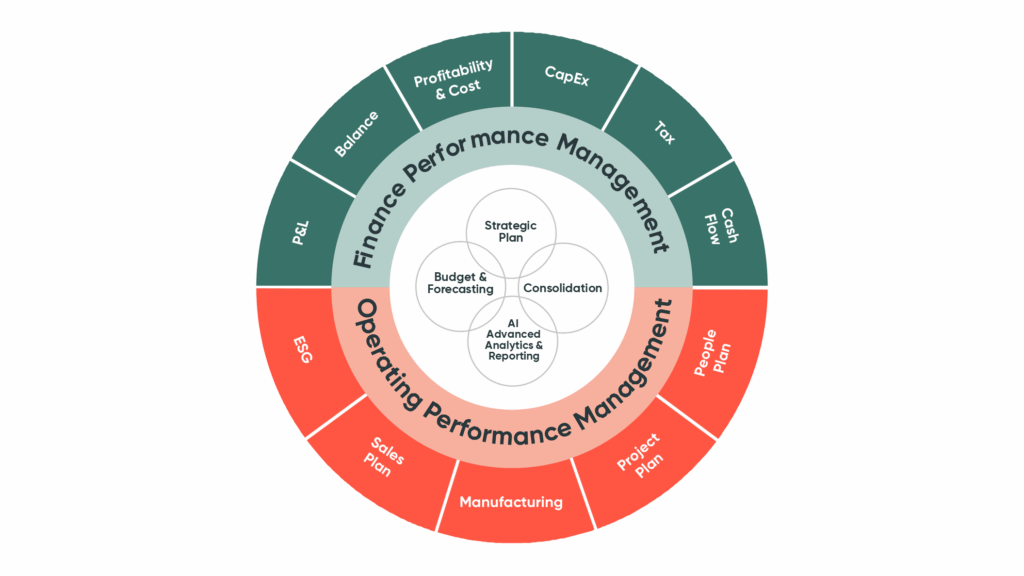
Budget & Forecasting
Preparation of short-term budgets and their updates throughout the year, as well as comparisons with actual data.
Advanced Analytics, AI, and Reporting:
Generation of all types of dashboards and reports—including tabular, graphical, and narrative formats—as well as the use of artificial intelligence and machine learning capabilities to analyze data
Frequently Asked Questions About Budgeting and Financial Planning
What is Financial Planning and Analysis (FP&A)?
It is the process of defining budgets, forecasting results and analyzing variances to make decisions. Connect Finance and Operations under a single version of the data.
What is the difference between a budget and a rolling forecast?
The budget sets annual goals; the rolling forecast updates them periodically (monthly/quarterly) based on actual business conditions, improving agility and accuracy.
What is driver-based planning, and why does it improve forecasting?
Model the business with drivers (price, volume, mix, productivity). When you change a driver, you can see the direct impact on P&L, balance sheet, and cash flow, with greater accuracy and speed.
What is the minimum data I need for a demand forecasting pilot?
Sales History Sales/Units, prices/discounts, variable/fixed costs and calendar. If possible, add Specials and seasonality to lower the MAPE.
How does it integrate with my ERP/BI and Microsoft 365?
They connect to transactional sources such as ERP/CRM/HR are connected for input, and outputs are published for analysis to BI or DataLake, reports within the EPM system itself, and integrated with Microsoft Office (Excel/PowerPoint/Word). There are roles and traceability by user.
How long does a typical implant procedure take?
An MVP is usually up and running within weeks (first use case). It then scales to OPEX/CAPEX, workforce, sales/S&OP and scenarios.
Is the cloud or on-premises better for EPM deployments?
The cloud The cloud accelerates deployment and automatic software updates, and reduces total cost of ownership and provides security updates. On-premises only when there are specific infrastructure requirements.
Take Control with Plan & Budget
Automate the budget cycle and forecasting, align departments, and gain real-time visibility to make confident decisions.
We'll help you identify your financial and data management challenges and figure out how to solve them.